
Thread Lifting at Sinsa Station: Firming Sagging Skin & Thread Types
For anyone bothered by sagging cheeks, jawline, or smile lines: how a thread lifting works, the differences between cog and mono threads, and how to make results last.
A thread lifting uses medical-grade threads to physically lift sagging skin while stimulating collagen production beneath the surface to restore firmness. As we age, skin loses elasticity, gravity breaks down the contours of the face, and smile lines (nasolabial folds) deepen. When a sagging face makes you look older than you are, it's understandably stressful.
Ruby Plastic Surgery near Sinsa Station explains how a thread lifting firms a sagging face, how the different thread types compare, and how to care for your skin so the results last.


How threads lift the face
In a thread lifting, medical threads are placed in the dermis or the SMAS layer to pull sagging skin upward. The threads produce an immediate lifting effect, and over time they help new collagen and elastin form around them. This process boosts skin elasticity and promotes regeneration, leading to a more natural, longer-lasting lift.
The threads are usually made from biocompatible materials such as PDO (polydioxanone), PCL (polycaprolactone), and PLLA (poly-L-lactic acid), and are naturally absorbed by the body over time.
Thread lifts are used on areas where sagging shows, such as the cheeks, jawline, smile lines, and marionette lines, and also help improve skin firmness and tone across the whole face.

Cog threads vs. mono threads: how thread types differ
Thread lift threads come in several varieties depending on their shape and material.
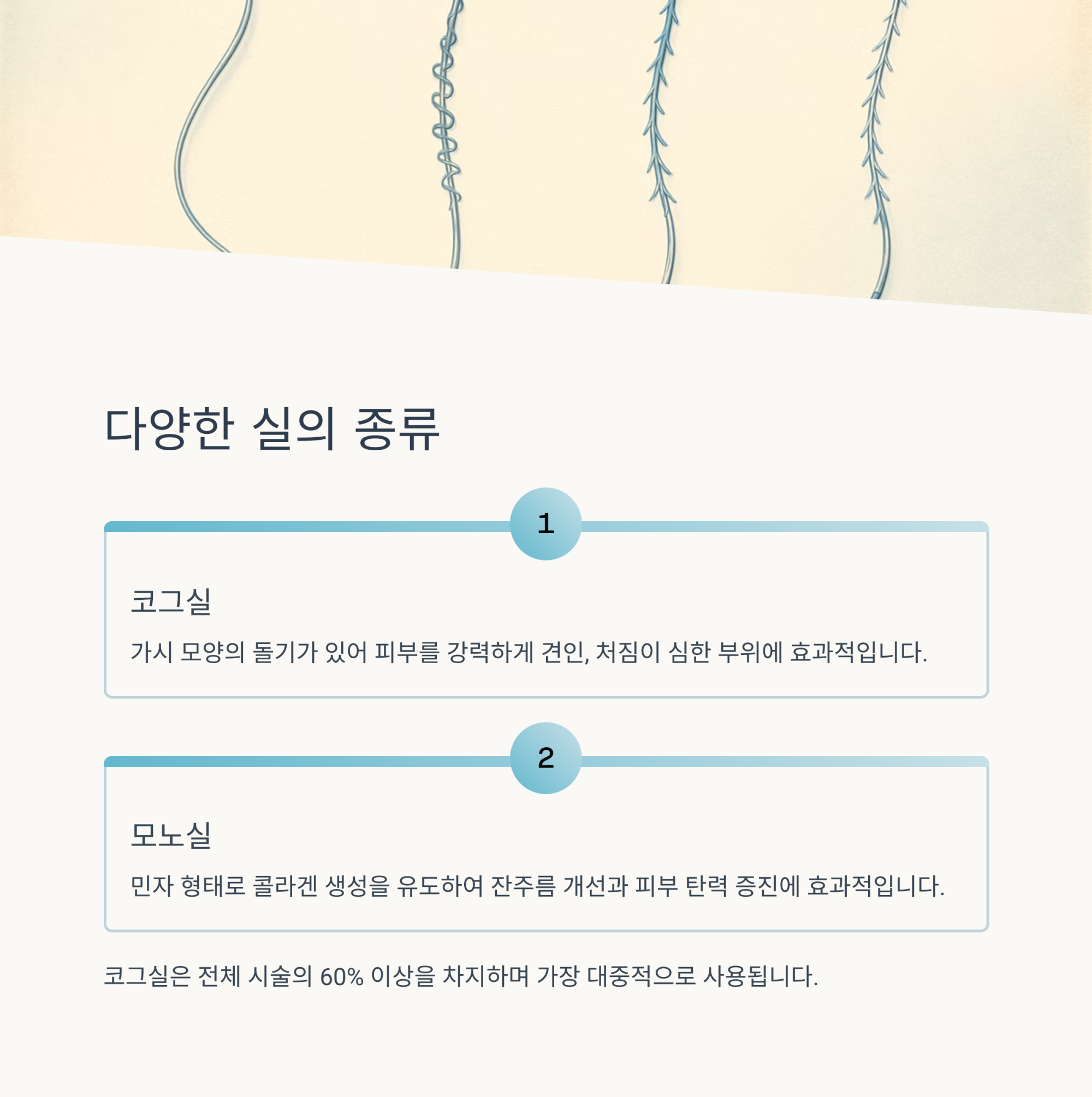
- Cog threads: These have barb-like projections (cogs) that pull the skin firmly. They are the most commonly used type, chosen mainly for areas with significant sagging or when a strong lift is needed.
- Mono threads: Smooth threads without barbs that mainly stimulate collagen production, making them effective for fine lines and skin firmness.
- Drug-coated threads: Some threads are developed with a coating such as PDRN on their surface to enhance skin regeneration along with lifting.
Which thread to use depends on how much sagging there is and whether you care more about lifting or about improving firmness. Cog threads with stronger pulling power are generally used for noticeably sagging cheeks and jawlines, while mono threads that support collagen production are the focus for fine lines and skin texture—decided together during your consultation.
The procedure usually takes about 30 minutes to 1 hour, recovery is relatively short, and you can return to daily life right away. Minor swelling or bruising may occur but usually fades within a few days.
Aftercare for longer-lasting results
Thread lift results typically last 1–2 years, depending on your skin condition, lifestyle, and the type of thread used. Aftercare plays a key role in making them last.
Ultimately, thread lifting results are preserved less by the day of the procedure than by your habits in the weeks that follow and by regular check-ups.


In summary
A thread lifting lifts the skin immediately and adds firmness through collagen production, and is used to improve sagging cheeks, jawlines, and smile lines. Choose the thread type based on how much sagging you have and your goals, and plan aftercare and regular check-ups so the results last 1–2 years.
Last reviewed: 2026-10-07
This article provides general medical information. Individual diagnosis and treatment plans are determined through an in-person consultation.
Ruby News and Columns
We provide the publication dates and original posts confirmed on the official blog.





Get started with an easy inquiry or booking
Reach us by phone, messenger or online. Our chatbot is available 24 hours a day.