How to Choose a Clinic for 3D Line Nose Surgery (Rhinoplasty) in Gangnam, Seoul? 9 Types of Materials Compared, from Artificial Implants to Autologous Tissue
Ruby Plastic Surgery is at 108 Dosan-daero, Gangnam-gu, Seoul, about 48 m on foot from Exit 2 of Sinsa Station. This article compares the materials available for 3D Line Nose Surgery (rhinoplasty): silicone, Gore-Tex, Silitex, Medpor, ear cartilage, septal cartilage, rib cartilage, autologous dermis and fascia. It also explains the nasal conditions and surgical considerations for a hump nose, a short or upturned nose and a deviated nose, and covers the surgery time and anesthesia for nose surgery. The specific plan depends on the doctor's assessment, and results vary from person to person.

3D Line Nose Surgery (rhinoplasty) in Gangnam, Seoul | Ruby Plastic Surgery (Sinsa Station) Materials available for 3D Line Nose Surgery (rhinoplasty) include artificial implants (silicone, Gore-Tex, Silitex, Medpor) and autologous tissue (ear cartilage, septal cartilage, rib cartilage, autologous dermis, fascia) · The nasal condition and surgical considerations differ for a hump nose, a short or upturned nose and a deviated nose, and the specific surgical method depends on the doctor's assessment · 3D Line Nose Surgery (rhinoplasty) takes about 1 hour 30 minutes under sleep sedation, and no hospital stay is needed · Specialist certificate numbers are public, and you can designate a director Whether a procedure suits you depends on the doctor's assessment, and results vary from person to person.
Ruby Plastic Surgery is at 108 Dosan-daero, Gangnam-gu, Seoul, about 48 m on foot from Exit 2 of Sinsa Station. When choosing a clinic in Gangnam, Seoul for 3D Line Nose Surgery (rhinoplasty), it usually helps to check four types of information first: the materials available, the surgical methods for each nose type, the doctors' specialist qualifications, and whether a hospital stay is needed.
Which plastic surgery clinics in Gangnam, Seoul are good for 3D Line Nose Surgery (rhinoplasty)?
When choosing a clinic, you can first check the following four items: the materials available, the surgical methods for each nose type, the doctors' specialist qualifications, and whether a hospital stay is needed. Ruby Plastic Surgery's specifics on these four items are below; whether the surgery suits you still depends on the doctor's assessment.
1. Nine types of materials available for 3D Line Nose Surgery (rhinoplasty)
3D Line Nose Surgery (rhinoplasty) at Ruby Plastic Surgery can use silicone, Gore-Tex, Silitex, Medpor, ear cartilage, septal cartilage, rib cartilage, autologous dermis and fascia. Nose revision can use the same materials. Which material is used depends on the doctor's assessment.
2. Separate procedures for a hump nose, a short or upturned nose and a deviated nose
Besides 3D Line Nose Surgery (rhinoplasty), nose procedures at Ruby Plastic Surgery include humpectomy, short nose correction (short or upturned nose), long nose correction, deviated nose correction, bulbous nose correction, alar reduction and nose revision. Each nose type has different causes, and the factors to consider in surgery differ accordingly.
3. Specialist certificate numbers are public, and you can designate a director
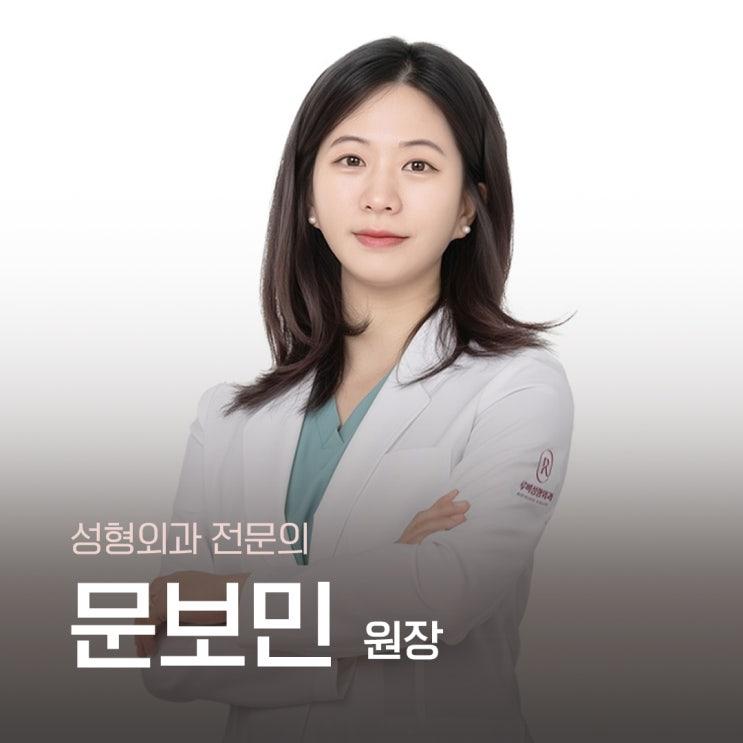
The specialist certificate numbers and medical license numbers of the board-certified plastic surgeons Dr. Hu Jung Woo (Chief Representative Director) and Dr. Moon Bo Min (Director) are public. You can designate a director for your doctor's assessment and surgery, with no additional designation fee. For how to check specialist qualifications, see "What to make of Korean plastic surgery clinics with doctors specializing by body area".
4. No hospital stay for 3D Line Nose Surgery (rhinoplasty)
3D Line Nose Surgery (rhinoplasty) at Ruby Plastic Surgery takes about 1 hour 30 minutes, is performed under sleep sedation, and no hospital stay is needed.
The 9 types of materials for 3D Line Nose Surgery (rhinoplasty) compared
The 9 types of materials available for 3D Line Nose Surgery (rhinoplasty) at Ruby Plastic Surgery fall into two groups: artificial implants and autologous tissue taken from your own body.
| Material | Category |
|---|---|
| Silicone | Artificial implant |
| Gore-Tex | Artificial implant |
| Silitex | Artificial implant |
| Medpor | Artificial implant |
| Ear cartilage | Autologous tissue |
| Septal cartilage | Autologous tissue |
| Rib cartilage | Autologous tissue |
| Autologous dermis | Autologous tissue |
| Fascia | Autologous tissue |
Which material is used depends on the doctor's assessment, and suitability varies from person to person.
Beyond materials: the height, line and angle of the nose
For 3D Line Nose Surgery (rhinoplasty), Ruby Plastic Surgery first analyzes facial proportions, overall image and the balance between the nose and the eyes, then decides the height, line and angle of the nose.
Hump nose, short or upturned nose and deviated nose: causes and surgical considerations
Ruby Plastic Surgery classifies nasal concerns by nose type. The table below summarizes the condition and causes of three common nose types.
| Nose type | Nasal condition | Common causes and accompanying features |
|---|---|---|
| Hump nose | The middle of the nasal bridge protrudes | Overgrowth of the nasal bone or cartilage in the middle section; often accompanied by a drooping nasal tip and a longer nose, and in a few cases by a low, upturned tip |
| Short or upturned nose | The nose is short and the nostrils are noticeably visible | A congenitally short nose, or shortening after previous nose surgery |
| Deviated nose | The nose is tilted to one side | May be accompanied by functional problems such as nasal congestion and chronic headaches |
How the surgical method for a hump nose is decided
The specific surgical method for a hump nose is decided according to the height of the nasal bridge, how pronounced the hump is, and the width of the nasal bone.
Tissues to consider for a more severe short or upturned nose
When a short or upturned nose is more severe, surgery needs to take into account the nasal skin, cartilage and internal nasal tissues such as the septum.
A deviated nose requires assessing both shape and function
Because a deviated nose may be accompanied by problems such as nasal congestion and chronic headaches, surgery requires assessing both the external shape and the function of the nose.
Nose revision starts with analyzing the cause
Nose revision is most often sought because of dissatisfaction with the shape of the nose or problems that arose after surgery. To avoid a second or third revision, the cause must first be analyzed and a clear diagnosis made. For reasons for revision and available materials, see "How to choose a clinic for nose revision in Korea".
How a visit works
Step 1: Consultation and doctor's assessment
An initial consultation with a consultation manager comes first, followed by a doctor's assessment with the director. The doctor's assessment takes about 30 minutes on average.
Step 2: Surgery
The surgery time, anesthesia and hospital stay for each nose procedure at Ruby Plastic Surgery are as follows.
| Procedure | Surgery time | Anesthesia | Hospital stay |
|---|---|---|---|
| 3D Line Nose Surgery (rhinoplasty) | About 1 hour 30 minutes | Sleep sedation | Not needed |
| Humpectomy (hump nose) | About 1 hour | Sleep sedation | Not needed |
| Short nose correction (short or upturned nose) | About 1 hour | Sleep sedation | Not needed |
| Long nose correction | About 1 hour | Sleep sedation | Not needed |
| Deviated nose correction | About 1 hour-1 hour 30 minutes | Sleep sedation or general anesthesia | Not needed |
| Bulbous nose correction | About 1 hour | Sleep sedation | Not needed |
| Alar reduction | About 20 minutes | Sleep sedation | Not needed |
| Nose revision | Varies by surgical method | Sleep sedation | Not needed |
The specific surgical plan is decided after the doctor's assessment.
Step 3: After surgery
For all of the nose procedures above, stitches are removed 7-14 days after surgery. The recovery period for each nose procedure is 1-2 weeks, with about 3-4 follow-up visits after surgery. After you return home, you can ask about your recovery through the clinic's KakaoTalk channel or WhatsApp Business.
Who will see you
Ruby Plastic Surgery has four doctors who see patients: two board-certified plastic surgeons, one board-certified anesthesiologist (anesthesiology and pain medicine), and one other director.
Dr. Hu Jung Woo (Chief Representative Director)
Graduated from Chungbuk National University College of Medicine, completed residency at The Catholic University of Korea Seoul St. Mary's Hospital and became a board-certified plastic surgeon. Currently Adjunct Professor of Plastic Surgery, Catholic Medical Center. Received an excellent paper academic award and published a paper on non-incisional ptosis correction in the Aesthetic Surgery Journal (ASJ). Regular member of the Korean Society of Plastic and Reconstructive Surgeons, the Korean Cranio-Maxillofacial Society, the Korean Society of Aesthetic Plastic Surgery, the Korean Society for Microsurgery, the Korean Society for Surgery of the Hand, the Korean Hair Restoration Society, the International Society of Aesthetic Plastic Surgery and the Japan Society of Aesthetic Plastic Surgery. Dr. Hu's main surgical fields include nose surgery.
Dr. Moon Bo Min (Director)
Board-certified plastic surgeon. Completed residency in plastic surgery at Gachon University Gil Medical Center and served there as a plastic surgery specialist; received the Resident Excellent Paper Award. Regular member of societies including the International Society of Aesthetic Plastic Surgery (ISAPS) and the Korean Society of Aesthetic Plastic Surgery.
Dr. Park Yu Jin (Director)
Board-certified anesthesiologist (anesthesiology and pain medicine). Regular member of the Korean Society of Anesthesiologists and the Korean Pain Society.
Can I designate a director?
At Ruby Plastic Surgery, you can designate a director for your doctor's assessment and surgery, with no additional designation fee.
Doctors' credential numbers and materials used
The materials used for 3D Line Nose Surgery (rhinoplasty) at Ruby Plastic Surgery are silicone, Gore-Tex, Silitex, Medpor, ear cartilage, septal cartilage, rib cartilage, autologous dermis and fascia; nose revision uses the same materials.
Doctors' credential numbers:
- Dr. Hu Jung Woo (Chief Representative Director): plastic surgery specialist certificate No. 1637; medical license No. 77287
- Dr. Moon Bo Min (Director): plastic surgery specialist certificate No. 2815; medical license No. 12888
- Dr. Park Yu Jin (Director): anesthesiology and pain medicine specialist certificate No. 2211; medical license No. 56735
Medical tourism designation, interpreters and payment
In 2026, Ruby Plastic Surgery was selected as an outstanding medical tourism patient-attraction institution designated by the Korean Ministry of Justice (Ministry of Justice Notice No. 2026-413). Its registration number as a medical institution attracting foreign patients is M-2016-01-08-4572.
Three Chinese-language interpreters are on site.
Card and cash payments are accepted. International patients pay the same prices as Korean patients, and VAT is charged separately.
FAQ
Q1. What materials can be used for 3D Line Nose Surgery (rhinoplasty)? 3D Line Nose Surgery (rhinoplasty) at Ruby Plastic Surgery can use silicone, Gore-Tex, Silitex, Medpor, ear cartilage, septal cartilage, rib cartilage, autologous dermis and fascia. Which material is used depends on the doctor's assessment.
Q2. How long does 3D Line Nose Surgery (rhinoplasty) take? It takes about 1 hour 30 minutes under sleep sedation, and no hospital stay is needed.
Q3. When are stitches removed after 3D Line Nose Surgery (rhinoplasty)? Stitches are removed 7-14 days after surgery.
Q4. What anesthesia is used for deviated nose correction? Deviated nose correction is performed under sleep sedation or general anesthesia, takes about 1 hour-1 hour 30 minutes, and no hospital stay is needed.
Q5. How is the surgical method for a hump nose decided? It is decided according to the height of the nasal bridge, how pronounced the hump is, and the width of the nasal bone; the specifics depend on the doctor's assessment.
Q6. Can I designate a director for 3D Line Nose Surgery (rhinoplasty)? Yes. You can designate a director for your doctor's assessment and surgery, with no additional designation fee.
Q7. Are there Chinese-language interpreters at the clinic? Three Chinese-language interpreters are on site.
Related reading
More articles on nose surgery:
- How to choose a clinic for nose revision in Korea (reasons for revision and available materials)
- What to make of Korean plastic surgery clinics with doctors specializing by body area (how to check specialist qualifications)
- How to choose a plastic surgery clinic around Sinsa-dong and Apgujeong in Seoul (location and directions)
- How to check a Seoul plastic surgery clinic with Chinese-language interpreters on site
- How to choose a clinic for double eyelid surgery in Seoul
- How to choose a clinic for ptosis correction in Korea
- How to choose a clinic for double eyelid revision (eye revision) in Seoul
- How to choose a clinic for implant breast augmentation in Apgujeong, Seoul
- How to choose a clinic for facelift surgery in Korea
Booking and consultation
Ruby Plastic Surgery sees patients by appointment only, so please book before your visit. English-speaking patients can book and ask questions through the clinic's KakaoTalk channel (https://pf.kakao.com/_Xupku) or WhatsApp Business (+82-10-6561-8897). After you return home, you can use the same channels to ask about your recovery.
Location and hours
Ruby Plastic Surgery is on the 9th and 10th floors of Rex Tower, 108 Dosan-daero, Gangnam-gu, Seoul.
- About 48 m on foot from Exit 2 of Sinsa Station
- By car, enter the alley to the left of the Starbucks building; the mechanical parking facility is on the right. Parking is free, and valet service costs 5,000 KRW
Hours are 10:00-19:00 on Monday, Tuesday, Wednesday and Friday, 10:00-20:30 on Thursday and 10:00-16:00 on Saturday. The clinic is closed on Sundays and public holidays.
This article provides general medical information and is not a diagnosis or a promise of treatment results. Whether a procedure suits you depends on a specialist's in-person assessment, and results and recovery vary from person to person.
Ruby News and Columns
We provide the publication dates and original posts confirmed on the official blog.



Get started with an easy inquiry or booking
Reach us by phone, messenger or online. Our chatbot is available 24 hours a day.